Fenix NTM
Super-matt, soft-touch and anti-fingerprint. Heals its own micro-scratches.
Not a paint and not a foil. It behaves unlike any other matt door, which is the whole point of it.
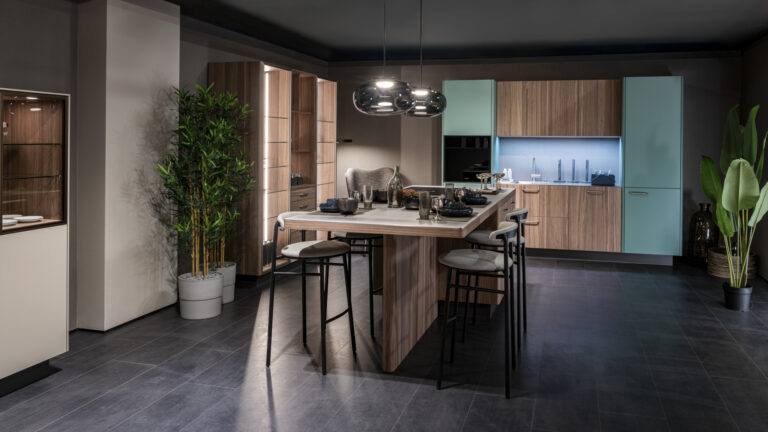
Fenix is a nanotech acrylic resin cured onto a board under heat and pressure — made by Arpa in Italy, and offered by Sachsenküchen across thirty-four colours. What you notice first is how little light comes back off it: a Fenix door reads as a solid block of colour rather than a panel with a sheen on it, and a run of them reads as one surface.
The practical reason people choose it is fingerprints. Fenix is the dark super-matt we are happy to specify in a family kitchen — a door that gets opened forty times a day and still looks the way it did at eight in the morning.
It also repairs its own light scuffing. Superficial marks can be worked out with heat: a damp cloth and a warm iron over the spot closes the fine scratching any surface picks up over years. No other finish on this page will do that.
Super-matt, which is not the same as matt
Light reflectivity is far lower than a standard matt lacquer. In practice that means no bright patch tracking across the doors as the sun moves, and colours that hold their depth in a north-facing room instead of going flat.
Anti-fingerprint, and it is the reason to specify it
The surface is closed rather than porous, so skin oils sit on it and lift off with a dry cloth. This is the single practical difference between Fenix and a conventional matt door, and it is worth handling both in the showroom to feel it.
It heals its own micro-scratches
Light surface marking can be closed with gentle heat — a damp cloth and a warm iron over the spot. Five minutes, no specialist, and the door looks new again.
Soft to the touch
It is noticeably warmer and less slippery under the hand than lacquer or glass. On a handleless kitchen, where you are pushing the door itself rather than a handle, that is something you feel every day.
Thirty-four colours, two thicknesses
Sachsenküchen lists Fenix fronts in 12mm and 40mm. The thicker front suits an island end or a tall bank where the extra depth reads as furniture; some décors carry the same face on both sides, which is what makes an open return or a peninsula end look right.
Where it comes into its own
Contemporary rooms and handleless runs, where the door itself is the surface you touch and nothing should interrupt it. It is the finish to ask for when you want the cabinetry to read as architecture.